
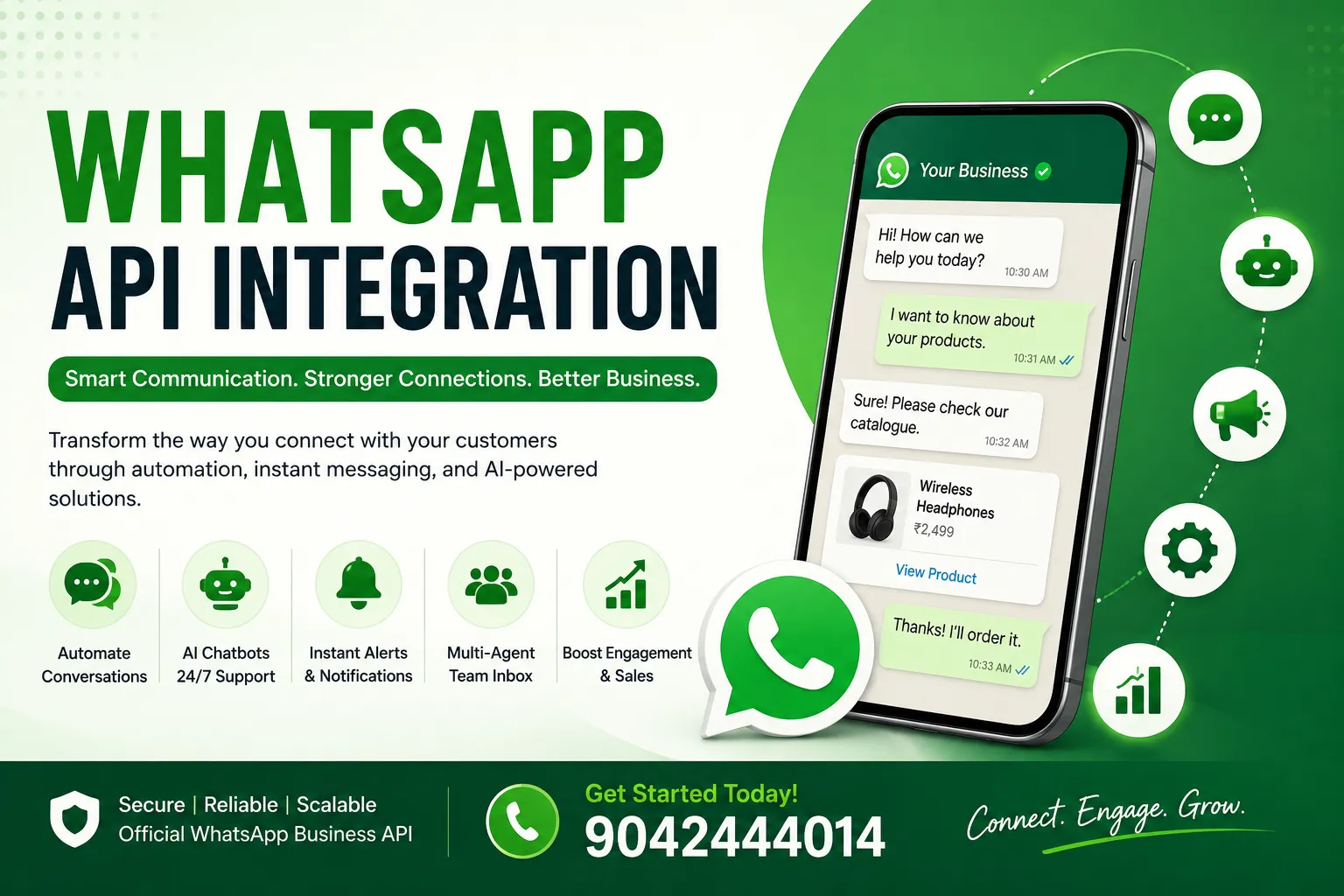
In today’s fast-moving digital world, customers expect instant communication, quick support, and personalized interactions from businesses. Traditional communication methods such as emails and phone calls are slowly being replaced by faster and more efficient messaging platforms. Among all messaging apps, WhatsApp has become the most popular communication channel worldwide, with billions of active users.
This is where WhatsApp API Integration becomes a game-changer for businesses of all sizes. Whether you run a small startup, an eCommerce store, a school, a healthcare center, or a large enterprise, WhatsApp API can help you automate communication, improve customer engagement, and increase sales.
In this blog, we will explore everything you need to know about WhatsApp API Integration, its benefits, features, use cases, and why your business should adopt it today.
WhatsApp API Integration is a business communication solution that allows companies to connect their systems, websites, CRMs, applications, and customer support platforms directly with WhatsApp.
Unlike the standard WhatsApp Business App, the API version is designed for medium and large businesses that handle large volumes of customer messages daily.
Using WhatsApp API, businesses can:
Send automated messages
Provide instant customer support
Share notifications and alerts
Send OTPs and verification messages
Automate marketing campaigns
Integrate with CRM and ERP systems
Build chatbot automation
The API enables seamless communication while maintaining the trusted and familiar WhatsApp experience customers already use daily.
Customers today prefer messaging over calling or emailing. WhatsApp offers several advantages that make it the ideal business communication platform.
WhatsApp is one of the most widely used messaging applications globally. Since most customers already use WhatsApp daily, businesses can easily connect with them on a familiar platform.
Email marketing often suffers from low open rates. WhatsApp messages, however, are usually opened within minutes. This makes WhatsApp an extremely effective communication channel.
Customers expect quick responses. WhatsApp API enables businesses to provide real-time communication and instant support.
Businesses can automate repetitive tasks such as:
Welcome messages
Order confirmations
Appointment reminders
Payment notifications
Customer support replies
Automation saves time and improves efficiency.
Customers appreciate faster support and personalized communication. WhatsApp API helps businesses create better customer relationships.
Businesses can send automated responses to customer queries, reducing manual work and improving response time.
Examples include:
Thank you messages
Order updates
Delivery tracking
Payment reminders
Appointment confirmations
Unlike the regular WhatsApp Business app, the API allows multiple team members to manage conversations from one number.
This is highly useful for customer support teams.
AI-powered chatbots can handle customer inquiries 24/7 without human intervention.
Chatbots can:
Answer FAQs
Capture leads
Book appointments
Process orders
Collect feedback
WhatsApp API can integrate with CRM systems to manage customer interactions more effectively.
This allows businesses to:
Track conversations
Store customer data
Manage leads
Improve customer relationships
Businesses can send promotional campaigns, offers, and announcements to multiple customers at once.
WhatsApp provides end-to-end encryption, ensuring secure communication between businesses and customers.
WhatsApp API is useful across multiple industries.
Online stores use WhatsApp API for:
Order confirmations
Shipping updates
Customer support
Promotional campaigns
Hospitals and clinics use it for:
Appointment reminders
Patient communication
Prescription notifications
Support services
Educational institutions use WhatsApp API to:
Send attendance updates
Share notices
Provide student support
Conduct communication with parents
Travel companies use it for:
Ticket confirmations
Travel alerts
Customer support
Booking assistance
Banks and financial institutions use WhatsApp API for:
OTP verification
Account alerts
Payment confirmations
Customer assistance
Real estate businesses use WhatsApp for:
Property inquiries
Lead generation
Site visit scheduling
Customer follow-ups
WhatsApp enables instant communication, helping businesses resolve customer issues quickly.
Quick responses and personalized communication can significantly improve conversion rates.
Customers are more likely to interact with businesses through messaging apps compared to emails.
Automation reduces the need for large customer support teams.
Chatbots and automated systems can provide round-the-clock customer assistance.
Using verified WhatsApp business accounts improves credibility and customer confidence.
Many businesses wonder about the difference between the regular WhatsApp Business app and WhatsApp API.
| Feature | WhatsApp Business App | WhatsApp API |
|---|---|---|
| Suitable for | Small businesses | Medium & large businesses |
| Multi-user support | Limited | Yes |
| Automation | Basic | Advanced |
| Chatbot support | No | Yes |
| CRM Integration | No | Yes |
| Broadcast scale | Limited | Large scale |
| API Access | No | Yes |
For businesses looking to scale communication and automate customer engagement, WhatsApp API is the better choice.
WhatsApp marketing is becoming one of the most effective digital marketing methods.
Businesses can send personalized messages based on customer behavior and preferences.
WhatsApp supports:
Images
Videos
PDFs
Product catalogs
Voice messages
Buttons and interactive messages
This makes campaigns more engaging.
Since customers actively use WhatsApp, response and conversion rates are much higher than traditional marketing channels.
Businesses need an official WhatsApp Business Solution Provider (BSP) to access the API.
Your business must complete verification through Meta.
Developers integrate the API with:
Websites
Mobile apps
CRM systems
Support software
WhatsApp requires businesses to use approved message templates for notifications and outbound communication.
Businesses can then start automating customer communication and support.
The future of business communication is conversational. Customers no longer want to wait on hold or receive delayed email responses.
WhatsApp API is rapidly evolving with features such as:
AI chatbots
Advanced automation
Payment integration
Interactive shopping experiences
AI-driven customer engagement
Businesses that adopt WhatsApp API early gain a competitive advantage by providing faster and smarter customer experiences.
If your business still relies only on phone calls and emails, you may be missing valuable customer engagement opportunities.
WhatsApp API helps businesses:
Improve communication
Increase customer satisfaction
Automate operations
Generate more leads
Boost sales
Build stronger relationships
Whether you are a startup or an established company, integrating WhatsApp API can transform the way you interact with customers.
WhatsApp API Integration is no longer just an optional tool — it has become an essential part of modern business communication.
With automation, instant messaging, CRM integration, chatbot support, and high engagement rates, WhatsApp API empowers businesses to deliver exceptional customer experiences while improving operational efficiency.
As customer expectations continue to rise, businesses that adopt smart communication technologies like WhatsApp API will stay ahead of the competition.
If you are looking to automate customer communication, improve support services, and grow your business, now is the perfect time to integrate WhatsApp API into your business operations.
Leadership, Finance, Operations, Growth, Product, Service, Sales, Marketing